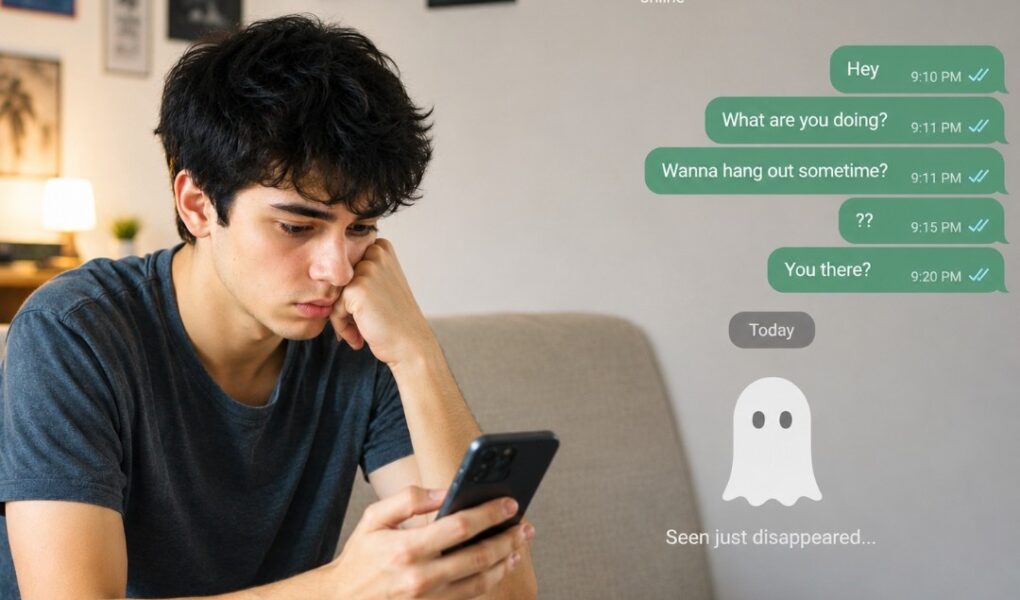
‘Ghosting’ refers to abruptly ending a romantic, platonic, or professional relationship without warning, with communication suddenly ceasing. The person who ghosts ignores all calls and messages, effectively vanishing without explanation.
Ghosting is often used as a passive-aggressive tactic to avoid conflict or explanations. The victim usually bears the emotional burden, feeling confused and disrespected, which can sometimes lead them to question their self-worth.
“Sometimes the cruellest goodbye is the one never spoken.”
Humans are ideal subjects for study due to their shifting moods and changing preferences. Moving forward is their characteristic, and they establish and dissolve multiple relationships over their lifetime. Because of opportunism, they develop many relationships at work and in their profession. These relationships are usually short-lived and typically end once their purpose is achieved, without any regrets or grievances. Both parties hold no grudges and do not burden their psyche.
The pain of a breakup or silence occurs when there is an emotional connection in the relationship, and one person is ghosting. The impact is on the receiver, who remains unaware and relies on their emotional bond, waiting for a response or some form of contact, often feeling hurt, confused, or rejected.
Ghosting can occur in specific situations where circumstances prevent the continuation or nurturing of a relationship. There is no malicious intent; it’s simply a matter of being unable to continue. The break is temporary, with the possibility of reconnecting in the future. These kinds of alliances occur frequently in our lives: we occasionally cease contact with a friend, only to reconnect years later and find ourselves at the same familiar stage, despite long periods of silence.
Ghosting, in its true sense, is simply not acknowledging someone rather than actively rejecting them. The recipient ends up questioning themselves about unresolved memories, repeatedly revisiting the media as if reading incomplete chapters of a book with an unclear or torn ending.
In an era dominated by iPhones and Androids, the individual continues scrolling through the screen, seeking a blue check or a message to mend the wounds of betrayal and jilt. The difficult part is that there’s no argument or conflict—only an incomprehensible silence.
This silence isn’t random or simply because of enjoyment; there is a deeper, underlying reason for ghosting someone –
* Emotional exhaustion occurs when people engage in trivial relationships with unnecessary emotional investments, leading to a state where they need solitude and mental silence to recover and relax. It all hinges on the kind of emotional investment involved during the building phases.
* Avoiding confrontation and cutting corners — A demanding relationship that constantly pushes and probes for personal satisfaction becomes burdensome. For mental peace, ghosting can be a convenient way to break free from this fleeting alliance.
* Some people enjoy treating relationships as temporary digital experiences. They engage in online relationships for fun, to boost their ego, or to gain social status.
Besides causing pain, ghosting gradually sends the message that people can be left without explanation and that relationships can be discarded without regret. It also implies that disappearing is better than being honest and apologetic.
The harsh reality is that 66 per cent of Gen Z and Millennials have been ghosted, and it’s safe to assume that most will ghost someone eventually.
So, is ghosting good or bad?
The core issue with ghosting is the emotionally unhealthy nature of the communication. It’s not that every relationship needs a dramatic goodbye, but honesty helps maintain the dignity of both parties; often, a brief, truthful message causes less pain than just vanishing.
“A door closes without a sound, and the mind keeps standing outside it for months.”
…………………….



The blog “Ghosting-A silent Good bye” in real terms seems to signify someone caught on a wrong foot, unintentionally as far as the receiver is concerned. The terminology is very new to us who are approaching seventies bracket.. A couple in love are so much anxious to meet their partner and get perturbed if a response is not received.As most of us might have gone through this anxiety. So, if suddenly, a big full stop comes and that too with out any explanation, is something that’s beyond imagination. This practice might be in vogue amongst GenZ or millennials. It’s something unheard of. A partner has all the right in the world to seek an explanation for the break up. If one suddenly, breaks all correspondences, talks and messages, it’s preposterous and might lead to an eventuality.It can be with either of the two. Love is feeling which is eternal, plutonic and pious in real sense, provided it’s a true love. Otherwise, physical attraction do not last.. Tu nahin toh koi aur sahi will work. Yes, the other side of the coin that’s suddenly breaking all communications, to some extent is nice.. As the person ghosting wants to avoid washing dirty linen in public. Allegations and counter allegations are kept at bay. They’ll spoil a chance of further negotiations and patch up. In such a scenario, there are chances that a reconciliation process of patch up may start after some time between the two. Nicely scripted Dr Anuj. Nice.
Dear Ashok Bhai how beautifully you have put your thoughts. You are right, there is a difference between what we have experienced and what we see now in the GenZ. I think it’s because of the availability of media and more resources of digital communications. In our days there was no way to ghost, but to confront the person and say sorry.
Regards.
Ghosting may seem like silence, but often it speaks the loudest. While distance can sometimes become necessary for peace and self-preservation, disappearing without a word can leave behind unanswered questions and quiet hurt. According to me human connections deserve honesty, even if brief, because closure is kinder than confusion.
Yet there are moments when walking away silently becomes the only way to protect one’s emotional well-being.
If you ask me ghosting is neither entirely cruel nor entirely justified — its explanation lies in the intention behind the silence just like any other action or situation…
…Sometimes ,the deepest silence
is simply a heart choosing peace over noise.
They say, Some goodbyes arrive without footsteps, like fading sounds and echoes in an empty hall….
Thank you so much Namrata for your feedback. I like the line … It’s true that sometimes walking away silently is the only way to protect from emotional turmoil.
Please do keep reading my blogs and posting your valuable views.
regards